

What does it do to a man -- to look Death in the eye, walk away, and live?
I have recently wondered if folks today are disconnecting from death. This got me thinking about war, and my relatives who fought in war. War is an obvious arena where death is far more prevalent than in day-to-day Americana.
My maternal grandfather (Rene) was a Marine who fought on Iwo Jima during World War II — the bloodiest battle of the Pacific theater. Of 80,000 soldiers who fought for the United States, more than 6,000 people died and 18,000 people were wounded. In other words, my grandfather had a nearly 10% chance of death just being in this battle.
Over the holidays, I sat down with my parents and asked them what Rene shared with them about his experience in war before he died. They shared a few stories.
Rene was in the second wave of Marines who landed on Iwo Jima. He was a machine gunner, a BAR operator. As a Marine, Rene’s job was to kill the enemy and protect his comrades. They landed on a beach and began moving inland.
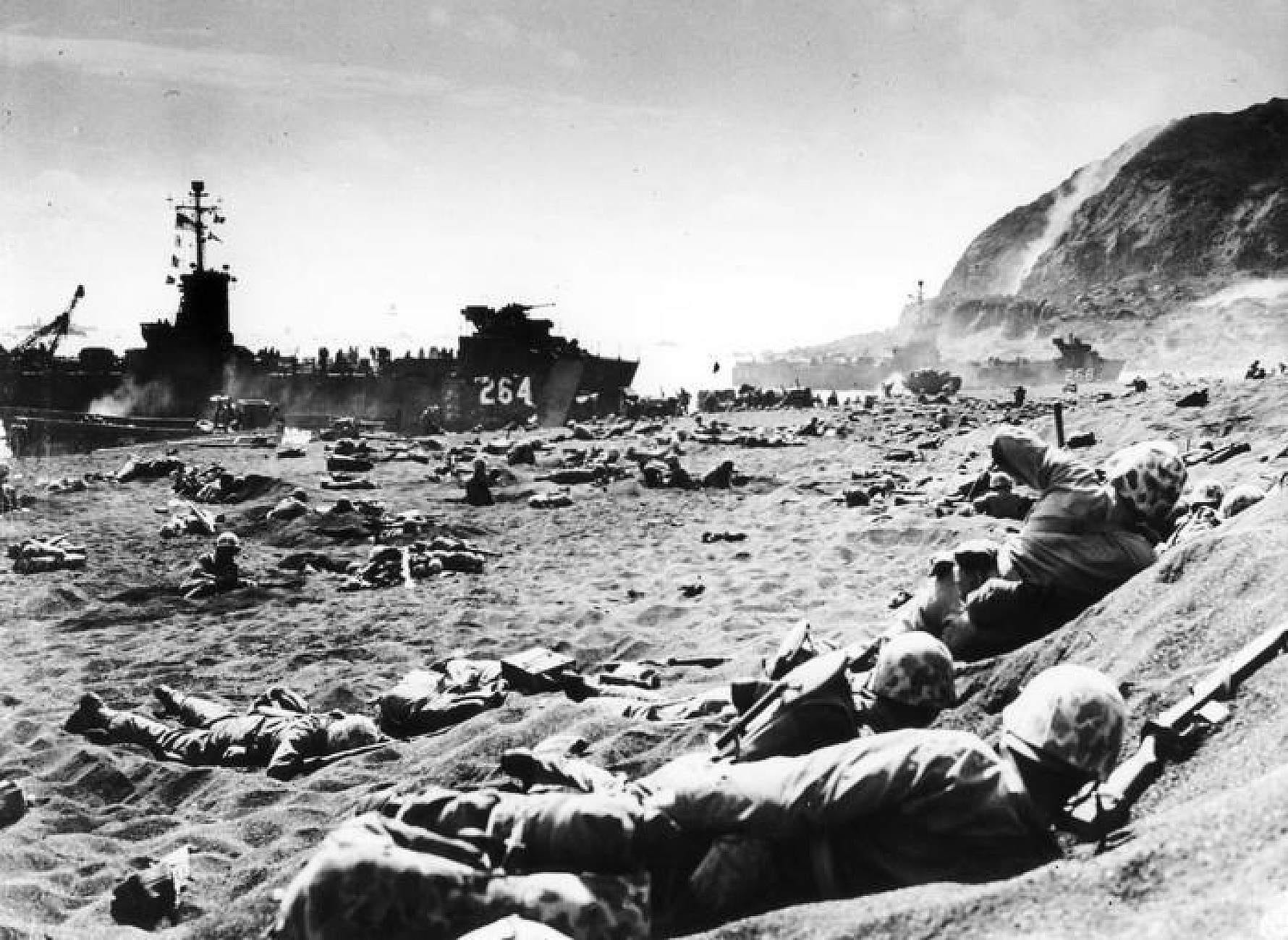
By the time he landed, the enemy had retreated to a tunnel network established for guerrilla warfare. His platoon was camped on the beach. At night, it was tough to sleep, because once the dark settled, voices would emerge from the tunnels and float out to sea:
Hey Joe, Hey Joe, You’ll be dead in the morning!
Then the enemy would sing a song.
The song was seared into my grandfather’s memory. I know this because he taught it to his children. My mother and aunt sang it for my family at Christmas. None of us had ever heard this before:
The enemy would fight from the tunnels in two ways. One, they would rush out in a banzai charge, altogether, aiming for overwhelming force in numbers. Two, they would sneak out alone and attempt to take out strategic positions, like Rene’s machine gun.
At one point, a single enemy combatant was sneaking upon Rene’s position, in a foxhole behind enemy lines. His platoon was advancing in a line beyond the combatant’s position. Rene left his foxhole and saw the combatant, who was playing dead. The man was armed and capture was a mortal risk.
E.O. Wilson writes in his excellent book Consilience, “Nature is a battlefield, make no mistake.” Sometimes in war, as in nature, you can’t make a moral choice. You must simply make the choice to live or die.
Rene was awarded a Bronze Star with the citation: “For heroic achievement in connection with operations against the enemy on IWO JIMA, VOLCANIC ISLANDS, during the period 25 February to 16 March, 1945. Private First Class [Rene], while serving with a Marine infantry battalion as an automatic rifleman, crawled through heavy enemy mortar and small arms fire, without regard for his own safety and without having been so ordered, and evacuated a wounded comrade who had fallen in front of the lines. Later, he engaged an enemy dual-purpose gun in a fire fight and rendered such accurate fire that his platoon was able to withdraw from an untenable position under cover of his fire. His devotion to duty and actions throughout were in keeping with the highest traditions of the United States Naval Service.”
On his deathbed, Rene said something like “I don’t know if I’ll go to heaven because of all the awful things I’ve done,” but he also said throughout his life, “I would do anything to keep my children and grandchildren from war.”
When Rene was fighting on Iwo Jima, he prayed,
Dear God, if I get out of this alive, I will never again have a bad day.
I remember my grandfather as a jolly, gentle man who was full of love, wit, and charm. As a kid, he would take me fishing on his boat, the Poliwog. When I think of him, I think of the smell of salt air, the smile on his face, and the pride in his very being. On the ocean, he was happy to be alive.
My mother recalled, “When my Mom was cranky, Dad would put on polka music. Then he would sweep her off her feet, and spin her around, and dance until she laughed. She couldn’t help but laugh. He loved her so much.”
This last story I love above all the others… My grandfather, the romantic.